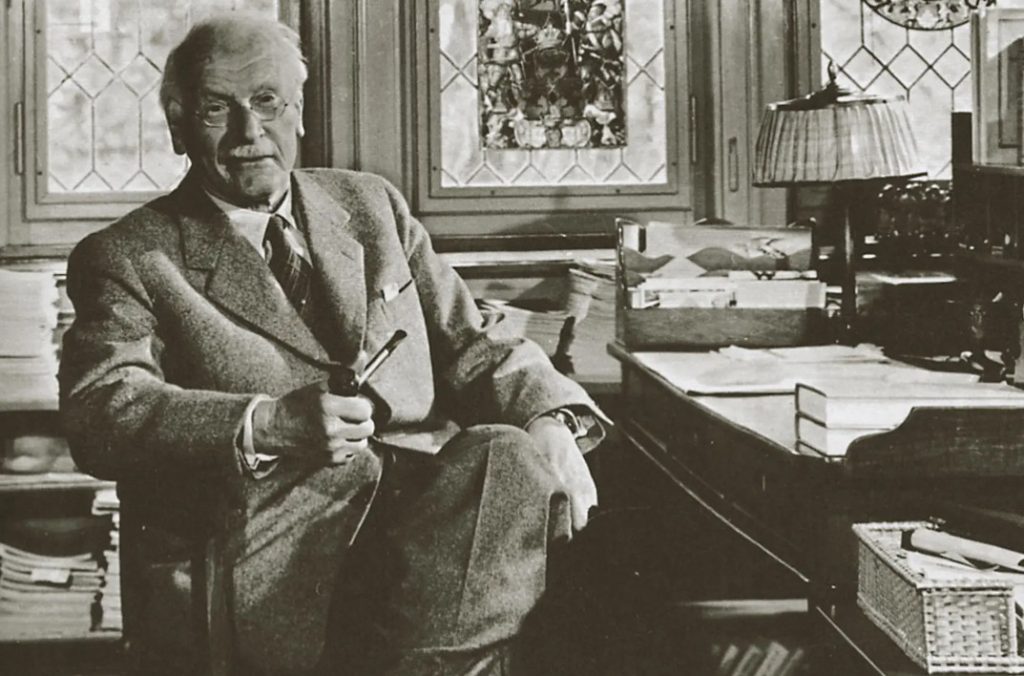

To picture Carl Gustav Jung is often to envision a distinguished, serene Swiss psychiatrist, whose deep intellect helped establish analytical psychology and gave the world enduring concepts such as archetypes, the collective unconscious, introversion, and extraversion. Yet behind his formidable academic presence lay an inner life steeped in visions, esoteric studies, and uncanny experiences that diverged radically from traditional clinical medicine. Jung lived in a world where the boundary between the psychological and the spiritual was fluid, spending long decades studying ancient alchemy, confronting vivid inner figures, and exploring paranormal phenomena with the same seriousness he applied to his psychiatric patients.
The story of Carl Jung is an extraordinary journey into the deep waters of the human psyche, where modern science met ancient mysticism. Rather than treating unusual subjective experiences as mere symptoms of mental illness, Jung used his own intense personal encounters with the unseen to formulate revolutionary theories about the mind. By exploring his life at the isolated stone tower he built in Bollingen, his lifelong fascination with ghosts and synchronicity, and his deep dive into alchemical symbolism, a vivid portrait emerges of a pioneer who dared to bridge the rational world of modern psychiatry with the ancient mysteries of the human soul.
The Tower at Bollingen: Building a Sanctuary for the Soul
In the early 1920s, seeking a place to escape the demands of urban life and the pressures of his medical practice, Carl Jung began constructing a primitive retreat on the shores of Lake Zurich. Located in the small village of Bollingen, this structure—which began as a simple circular stone tower—was built largely by hand and evolved gradually over several decades into a multi-turreted sanctuary. Jung designed the Bollingen Tower without modern conveniences, deliberately choosing to live without electricity, indoor plumbing, central heating, or a telephone. For Jung, this raw, elemental lifestyle was not self-denial but a vital psychological necessity.
At Bollingen, Jung returned to a basic, timeless existence. He chopped his own firewood, cooked his meals over an open fire, drew water from a well, and spent hours carving meaningful symbols and inscriptions into the stone walls and freestanding boulders around the property. Free from the distractions of modern civilization, Jung felt he was in direct contact with his ancestors and the natural rhythms of the earth. He viewed the tower as a physical representation of his own psychic structure, describing it as a place where he could fully be himself and allow his thoughts to reach back into ancient times.
Solitude, Handcraft, and Dialogue with the Inner Self
The daily routine at Bollingen offered Jung the quietude required to engage in deep introspection and intense creative work. Away from the analytical couch and academic rivalries, he spent long hours painting, sculpting stone, and writing in complete solitude. Jung believed that manual labor and contact with simple physical materials grounded the mind, allowing deep unconscious material to rise safely to conscious awareness. The tower provided a sacred space where the conscious ego could converse with the vast, unexplored regions of the mind without interruption.
It was in this solitary retreat that Jung spent decades working on his legendary Red Book, an illuminated manuscript bound in red leather in which he recorded and illustrated his intense personal visions and internal dialogues. Working by candlelight in the quiet rooms of Bollingen, Jung documented his encounters with internal figures such as Philemon, an imaginary wise old man who served as a spiritual guide. These intense solitary experiences convinced Jung that the human psyche contains autonomous inner figures that speak with their own wisdom, a core discovery that would shape his clinical understanding of dream interpretation and active imagination.
The Symbolic Architecture of the Self
For Jung, the physical evolution of the tower mirrored his personal journey toward psychological wholeness, a process he termed individuation. The original central tower represented the psyche’s maternal core, while later additions corresponded to different stages of his intellectual and emotional development. Each stone added to the complex represented an integration of unconscious material into his conscious life.
Outside the tower, Jung carved a large, square stone block with Latin inscriptions and esoteric symbols, dedicating it to the spirit of the place. This carved stone served as a monument to the mysterious, eternal aspect of the human personality that exists beyond the temporary ego. Bollingen was not merely a summer home or a weekend hideaway; it was a physical manifestation of Jung’s inner universe, a sacred laboratory where the father of analytical psychology lived in harmony with the ancient instincts of the human spirit.
Ghosts, Spirits, and the Reality of Paranormal Phenomena
Throughout his long life, Carl Jung maintained an active interest in the paranormal, investigating mediumship, séances, apparitions, and telepathy with keen scientific curiosity. Jung’s interest in the supernatural was not merely academic; he was raised in an environment saturated with spiritualism. His mother and several extended family members frequently held séances and reported seeing ghosts, while Jung himself experienced unexplained physical occurrences from an early age. His doctoral dissertation, completed in 1902, was a clinical study of his cousin, Helly Price, a young medium who claimed to channel spirits while in trance states.
Jung refused to dismiss paranormal reports as simple delusions, fraud, or mental illness. Instead, he sought to understand the psychological mechanisms behind them. While early in his career he tended to view mediumistic spirits as autonomous fragments of the subconscious mind—repressed feelings or thoughts breaking through into consciousness—his later personal experiences convinced him that the boundary between mind and physical matter was far more complex than mainstream science acknowledged.
The Poltergeist in Freud’s Bookcase
One of the most famous supernatural encounters in Jung’s life occurred in 1909 during a meeting with Sigmund Freud in Vienna. The two men were engaged in a heated debate regarding occult phenomena, which Freud firmly dismissed as unscientific nonsense. As Freud was voicing his skepticism, Jung felt a strange, burning sensation in his abdomen, accompanied by intense psychological tension. Suddenly, a loud cracking noise echoed from a nearby heavy wooden bookcase, startling both men.
Jung immediately claimed that the noise was a manifestation of what he called a catalytic exteriorization phenomenon, predicting that another loud crack would occur moments later. To Freud’s utter astonishment, a second explosive crack echoed from the bookcase as soon as Jung finished speaking. While Freud remained deeply shaken and skeptical, Jung viewed the event as proof that intense emotional states within the mind could interact directly with the physical environment, a insight that laid the groundwork for his later concept of meaningful coincidence.
The Haunted House and the Concept of Synchronicity
Jung experienced numerous uncanny events throughout his career. While staying in an old country house in England, he reported experiencing persistent hauntings, including unexplainable sounds, cold spots, and vivid nightly visions that made sleep impossible. Rather than reacting with terror, Jung carefully documented the phenomena, seeking to understand how place, memory, and human consciousness interact to create ghost experiences.
These strange encounters eventually led Jung to collaborate with the quantum physicist Wolfgang Pauli to develop the theory of synchronicity. Defined as an acausal connecting principle, synchronicity describes occurrences where an internal psychological state and an external physical event coincide in a meaningful way, without any direct cause-and-effect relationship. Jung used this concept to explain apparitions, telepathic feelings, and coincidences, arguing that mind and matter are ultimate expressions of a single, underlying reality that briefly reveals itself through meaningful events.
The Alchemical Journey: Unlocking the Symbols of Transformation
In the late 1920s, Carl Jung made a discovery that would define the final decades of his research: the historical literature of medieval alchemy. To the modern scientific mind, alchemy is largely viewed as a primitive, misguided precursor to chemistry, a futile attempt by foolish men to turn lead into gold. However, as Jung began collecting and reading ancient, obscure alchemical treatises in Latin and Greek, he realized the alchemists were describing something far deeper: a rich, symbolic language of psychological transformation.
Jung realized that when the ancient alchemists gazed into their bubbling flasks and retorts, they were unconsciously projecting their own internal psychological processes onto the physical materials. The elaborate recipes involving dragons, red lions, green queens, and chemical weddings were not merely instructions for working with metals, but vivid symbolic descriptions of the human mind undergoing a grueling journey from psychological chaos to inner wholeness and spiritual integration.
The Magnum Opus as Psychological Integration
In classical alchemy, the great work of creating the Philosopher’s Stone—the magical substance capable of turning base metals into precious gold and granting immortality—followed a specific series of distinct color stages. Jung recognized that these physical stages corresponded precisely to the major phases of his own clinical process of psychological integration and healing:
The first stage, known as the nigredo or blackness, represented the initial encounter with the dark, unacknowledged aspects of the personality—what Jung named the Shadow. This painful stage involved despair, confusion, and the collapse of ego pride, mirroring the deep depression or emotional crisis that often brings a patient into psychotherapy.
The second stage, the albedo or whiteness, represented a period of purification, self-reflection, and emotional clarity, where the individual gained insight into their inner drives. Finally, the rubedo or redness represented the ultimate union of opposing psychological forces within the mind, leading to the creation of the Self, symbolized in alchemy by the Philosopher’s Stone or Gold.
Bridging Ancient Wisdom and Modern Psychiatry
Jung spent thousands of hours studying rare alchemical manuscripts, building an extensive private library of medieval texts at his home in Küsnacht. He filled his major works, such as “Psychology and Alchemy” and “Mysterium Coniunctionis,” with detailed analyses showing that the spontaneous dream symbols of his modern, non-religious psychiatric patients matched the complex imagery drawn by medieval alchemists centuries earlier.
This discovery was profound for analytical psychology. It demonstrated that human beings across different eras, cultures, and geographical locations draw upon a shared reservoir of primordial imagery, which Jung named the collective unconscious. Alchemy provided historical proof for Jung’s theories, showing that the drive toward inner wholeness was a timeless, universal feature of the human mind, expressed through dreams, myths, and esoteric symbols throughout human history.
Conclusion: The Legacy of a Visionary Physician
Carl Jung’s willingness to step beyond the boundaries of conventional medical science earned him both intense admiration and sharp criticism from his contemporaries. Where traditional psychiatry saw only brain chemistry and illness, Jung saw an incredible cosmic tapestry of dreams, symbols, myths, and spiritual longing. His personal journey—from building the solitary stone tower at Bollingen to exploring haunted houses and deciphering ancient alchemical manuscripts—was driven by an unyielding desire to understand the full breadth of the human experience.
Ultimately, Jung’s eccentricities were not signs of detachment from reality, but rather the courageous explorations of a scientist who refused to ignore the deep mysteries of existence. By honoring both the dark, chaotic depths of the unconscious mind and the highest aspirations of the human spirit, Carl Jung forever transformed our understanding of psychology, leaving behind a rich legacy that continues to inspire seekers, clinicians, and thinkers around the world.
FAQ About Carl Jung’s Mystical Side
Why did Carl Jung build the tower at Bollingen without modern amenities?
Carl Jung built the Bollingen Tower without electricity, indoor plumbing, or modern heating because he wanted a quiet sanctuary where he could strip away the distractions of modern urban life and live in direct contact with nature. He believed that chopping firewood, cooking over an open fire, and living simple days allowed him to connect deeply with his subconscious mind and his ancestors, providing the solitude required for creative writing, stone carving, and intense inner work.
What was Carl Jung’s Red Book?
The Red Book, or Liber Novus, was a large, red-leather-bound manuscript in which Carl Jung spent decades recording and illustrating his intense personal visions, waking dreams, and internal dialogues. Created during a period of deep self-exploration following his painful professional split from Sigmund Freud, the book contains elaborate, colorful artwork and narratives documenting Jung’s encounters with autonomous inner figures, serving as the primary raw material from which he developed his core theories of archetypes and the collective unconscious.
How did Carl Jung view medieval alchemy?
Carl Jung viewed medieval alchemy not as a misguided precursor to modern chemistry, but as a symbolic system that described psychological transformation. He argued that alchemists unconsciously projected their own inner mental processes onto physical materials, using terms like the Philosopher’s Stone, the chemical wedding, and transformation stages to describe the journey toward psychological integration, self-realization, and wholeness.
What was the poltergeist incident between Jung and Freud?
The poltergeist incident occurred in 1909 during a meeting in Vienna between Carl Jung and Sigmund Freud. While arguing about paranormal phenomena, Jung felt an intense sensation in his abdomen, followed by an explosive cracking sound from a nearby bookcase that startled both men. Jung predicted a second crack would occur immediately, which it did. Jung viewed the event as a catalytic exteriorization of emotional tension, while Freud remained deeply skeptical, contributing to the growing personal strain between the two men.
What is the concept of synchronicity created by Jung?
Synchronicity is a concept developed by Carl Jung, in collaboration with physicist Wolfgang Pauli, to explain meaningful coincidences that have no clear cause-and-effect relationship. Jung defined it as an acausal connecting principle, where an inner psychological state (such as a dream, premonition, or feeling) coincides with a matching external event in the physical world, suggesting that mind and matter are deeply connected in a unified underlying reality.
Recommended Books on Carl Jung
- Memories, Dreams, Reflections by C. G. Jung
- Jung: A Biography by Deirdre Bair
- The Red Book: Liber Novus by C. G. Jung
- Psychology and Alchemy by C. G. Jung
- The Mystery of the Conjunction: C.G. Jung’s Psychology and Alchemy by Edward F. Edinger