Polyvagal theory, developed by Stephen Porges, revolutionizes our understanding of how the autonomic nervous system regulates safety, stress, and social behavior. This neurophysiological framework explains why humans thrive in connection yet collapse under threat, linking biology to emotions and relationships. For psychology professionals and individuals seeking healing, it offers insights into trauma recovery, anxiety management, and building resilience.
This article explores the core principles of polyvagal theory, its three neural pathways, clinical applications, and practical tools for applying Porges’ discoveries. Readers learn to map nervous system states, foster safety cues, and transform stress responses into adaptive engagement.
Conceptual Framework
Polyvagal theory posits that the vagus nerve, with its dorsal and ventral branches, orchestrates survival through a hierarchy of responses: social engagement, mobilization, and immobilization. Unlike traditional fight-flight-freeze models, it emphasizes neuroception—unconscious detection of safety or danger—guiding behavior before conscious awareness. Porges introduced this in 1995, integrating evolutionary biology, anatomy, and psychology.
The theory highlights myelinated ventral vagal pathways for calm connection versus unmyelinated dorsal paths for shutdown, explaining varied trauma responses. It shifts focus from cognition to physiology, revealing how body states drive emotions and actions.
Neuroception scans environments for cues of safety, danger, or life-threat, bypassing the cortex for rapid autonomic shifts. Vagal tone measures resilience: high tone enables quick recovery from stress via heart rate variability. The social engagement system integrates facial expressions, prosody, and gestures for mammalian bonding.
Evolutionary phylogeny ranks responses: newest ventral vagal for connection, sympathetic mobilization for action, oldest dorsal vagal for conservation. This hierarchy prioritizes safety-seeking through affiliation when possible.
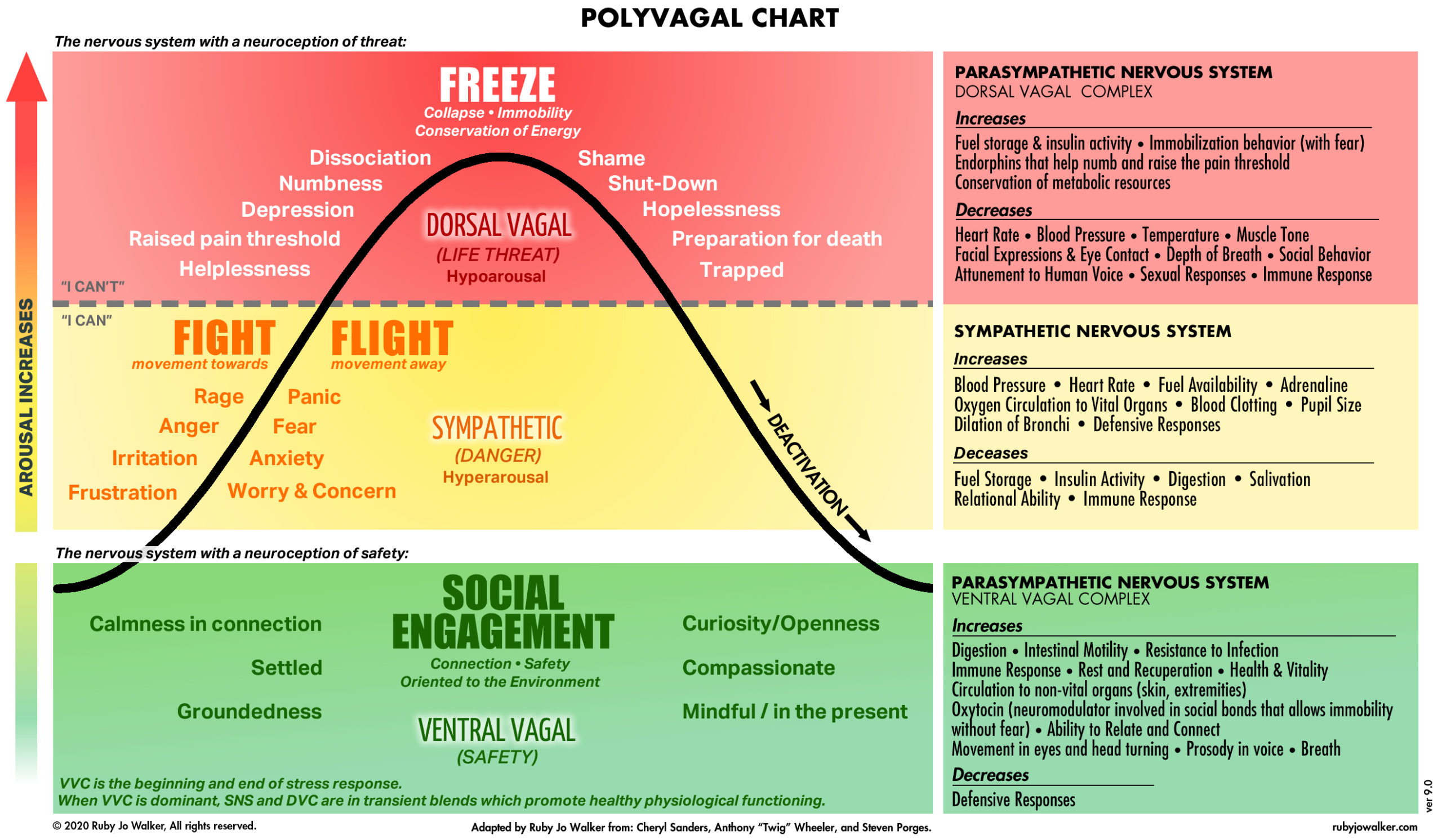
The Three Polyvagal Pathways
Ventral Vagal: Social Engagement and Safety
The ventral vagal complex, myelinated and recent evolutionarily, governs calm states, prosocial behavior, and co-regulation. Active during safe interactions, it slows heart rate, promotes vocal warmth, and facilitates listening. Facial nerves link it to expressions conveying trustworthiness, essential for therapy and relationships.
When dominant, individuals feel present, connected, and playful. Deficits lead to disconnection, as trauma dampens ventral tone, requiring cues of safety to reactivate.
Sympathetic: Fight or Flight Mobilization
Sympathetic activation mobilizes energy for defense: increased heart rate, adrenaline surge, and hyperarousal prepare action against threats. This adaptive in danger becomes chronic in anxiety, fueling anger, panic, or escape urges. Polyvagal theory notes it follows failed social engagement attempts.
Prolonged states exhaust resources, eroding ventral pathways and risking collapse into dorsal dominance. Regulation involves downshifting via breath or safety signals.
Dorsal Vagal: Freeze and Shutdown
The unmyelinated dorsal vagal complex triggers immobilization: dissociation, numbness, or collapse to conserve energy under overwhelming threat. Evolutionarily ancient, it mimics death feigning in prey, slowing metabolism profoundly. In humans, it manifests as depression, fatigue, or fainting.
Trauma survivors cycle here during helplessness, needing gentle titration to ascend the ladder toward engagement. Abrupt arousal risks rebound shutdowns.
Neuroception and Cues of Safety
Neuroception operates subconsciously, appraising faces, voices, and postures for danger. Ambiguous cues—like flat affect or harsh tones—prompt defensive shifts, even rationally safe. Therapy leverages this by cultivating predictable, warm prosody and eye contact.
Safety cues recalibrate the system: soft voices, rhythmic breathing, and gentle touch signal ventral activation. Environments matter: clutter or chaos registers as threat, hindering regulation.
Psychological Impacts and Trauma Applications
Trauma and Polyvagal Mismatch
Trauma dysregulates the hierarchy, trapping individuals in sympathetic rage or dorsal despair. Childhood adversity impairs vagal tone, heightening reactivity and reducing social capacity. Complex PTSD shows dorsal dominance, with dissociation as default safety.
Anxiety, Depression, and Social Disorders
Anxiety reflects sympathetic lock-in, depression dorsal shutdown. Autism and ADHD involve ventral challenges, mistaking neutral cues as threat. Polyvagal interventions restore balance, improving attunement.
Attachment and Relationships
Insecure attachments stem from mismatched states: anxious pursuit chases unavailable partners in shutdown. Secure bonds co-regulate via ventral synchrony, mirroring heart rates and breaths for calm.
Individual Differences and Vulnerable Groups
High sensitivity amplifies neuroception, overwhelming sympathetic responses. Neurodiverse individuals process cues atypically, benefiting from explicit safety signals. Women show stronger ventral-social links, men more sympathetic dominance culturally.
Aging reduces vagal flexibility, while chronic illness entrenches dorsal states. Cultural norms influence expression: collectivist societies prioritize group ventral cues over individual.
Specific Mental Health Outcomes
Hyperarousal and Chronic Stress
Sympathetic persistence elevates cortisol, fostering insomnia, irritability, and cardiovascular strain. Polyvagal mapping reveals triggers, guiding de-escalation.
Hypoarousal and Dissociation
Dorsal states numb emotions, mimicking depression with flat affect and withdrawal. Recovery titrates sensation to rebuild tolerance.
Impaired Social Engagement
Ventral deficits hinder empathy and trust, isolating despite desire for connection. Interventions rebuild through micro-moments of safety.
The Window of Tolerance and Ladder of States
The window of tolerance describes optimal arousal for functioning; trauma narrows it, pushing extremes. Polyvagal ladder visualizes ascent: dorsal base to sympathetic middle to ventral top. Interventions pendulate within windows, expanding capacity.
Co-regulation with safe others widens windows faster than solo efforts, underscoring therapy’s power.
Therapeutic Applications
Somatic and Body-Based Therapies
Somatic Experiencing uses pendulation to discharge dorsal energy safely. Safe and Sound Protocol (SSP), Porges’ auditory intervention, tunes ventral pathways via filtered music, calming neuroception.
Clinical Techniques
Mindfulness anchors ventral states; EMDR integrates with polyvagal tracking. Couples therapy teaches attunement: matching prosody rebuilds bonds. Play therapy activates ventral play circuits naturally.
Evidence-Based Recommendations for Individuals
Practice prosodic listening: hum, sing, or chant to stimulate vagus. Vagal maneuvers like cold exposure or gargling boost tone. Create safety rituals: dim lights, soft fabrics, rhythmic movement.
Track states daily, noting triggers and shifts. Seek reciprocal relationships for co-regulation. Breathwork—exhales longer than inhales—downregulates sympathetics.
Recommendations for Therapists and Organizations
Therapists embody ventral cues: warm voice, grounded posture. Titrate sessions to client windows, validating states without rushing. Organizations design safe spaces: natural light, plants, quiet zones enhance neuroception.
Training in polyvagal-informed leadership fosters team regulation, reducing burnout.
Future Directions and Research
Ongoing studies validate SSP efficacy and vagal biomarkers. Integration with AI biofeedback promises personalized regulation. Cross-cultural applications address diverse neuroceptions.
Gaps include longitudinal ventral development and interventions for severe dysregulation, expanding polyvagal’s reach.
Closing Section
Polyvagal theory illuminates the body’s quest for safety, transforming psychology from mind-centric to embodied. By honoring neural pathways, individuals and clinicians cultivate connection over defense. Porges’ legacy empowers nervous systems worldwide toward resilience and belonging.
FAQ
What is neuroception in polyvagal theory?
Neuroception in polyvagal theory refers to the subconscious, automatic scanning process conducted by the autonomic nervous system to detect cues of safety, danger, or life-threatening situations in the environment, influencing behavioral states without conscious input or cognitive evaluation. This rapid mechanism evolved for survival, prioritizing physiological responses like social engagement or shutdown based on subtle signals such as facial expressions, vocal tones, or postural changes long before the thinking brain registers them. Understanding neuroception allows individuals to intentionally shape their environments with safety signals, recalibrating the system toward ventral vagal calm and connection over time.
How does ventral vagal activation feel?
Ventral vagal activation feels like a state of grounded presence, ease in social interactions, warmth in the chest, steady relaxed breathing, and genuine curiosity toward others, accompanied by fluid facial expressions and a sense of playful safety that invites mutual engagement. Physically, it manifests as lower heart rate variability smoothness, clear vocal prosody, and effortless listening without defensive scanning. Emotionally, it brings joy, trust, and emotional flexibility, contrasting hypervigilant tension or numb withdrawal, and sustains through reciprocal co-regulation in safe relationships.
Can polyvagal theory help with anxiety disorders?
Polyvagal theory helps with anxiety disorders by identifying sympathetic hyperarousal as a failed bid for social safety, guiding interventions to strengthen ventral pathways through safety cues, breathwork, and prosodic exercises that interrupt escalation cycles at their physiological root. It reframes anxiety not as personal weakness but as adaptive mobilization gone awry, reducing shame and enabling targeted regulation like longer exhales to engage parasympathetic brakes. Over time, consistent practices expand the window of tolerance, diminishing chronic fight-flight loops and fostering resilience against triggers.
What role does the vagus nerve play in emotions?
The vagus nerve plays a central role in emotions by serving as the primary conduit for bidirectional communication between the brain and body, modulating heart rate, gut function, and facial muscles to orchestrate states from calm engagement to shutdown based on safety perceptions. Its ventral branch promotes positive social emotions like love and trust through myelinated fibers enabling rapid calming, while dorsal paths link to immobilization emotions such as despair or dissociation during overwhelm. Enhancing vagal tone through stimulation techniques improves emotional regulation, resilience, and interpersonal attunement across mental health challenges.
How to apply polyvagal theory in daily life?
Applying polyvagal theory in daily life involves cultivating awareness of current states through body scans, then using safety cues like humming, gentle rocking, or eye contact with trusted people to shift toward ventral activation during stress. Design environments with soft lighting, plants, and rhythmic sounds to positively influence neuroception, and practice co-regulation by mirroring calm breaths in conversations to downregulate sympathetics collectively. Track progress with journals noting state transitions, building habits that ladder from dorsal numbness through mobilization to sustained social engagement for lasting well-being.
Recommended Books
- The Polyvagal Theory: Neurophysiological Foundations of Emotions, Attachment, Communication, and Self-regulation by Stephen W. Porges
- Polyvagal Safety: Attachment, Communication, Self-Regulation by Deb Dana
- Accessing the Healing Power of the Vagus Nerve: Self-Help Exercises for Anxiety, Depression, Trauma, and Autism by Stanley Rosenberg
- Waking the Tiger: Healing Trauma by Peter A. Levine
- Anchored: How to Befriend Your Nervous System Using Polyvagal Theory to Feel Safe, Alive, and Empowered by Deb Dana